Building AI Agents: A Workshop
Sitting at the Feet of a Master: The AI Agent Blueprint
I’ve spent the last few years tinkering with AI, but recently I felt like I hit a wall. I was building agents that were fine, but they weren't great. Then, I sat back and watched a workshop by Ras Mic—one of the most knowledgeable guys in the game when it comes to building productive AI agents.
I took pages of notes so you don't have to. If you’ve ever felt like your AI agent is a brilliant but disorganized intern, this is the roadmap you’ve been waiting for.
The Core Philosophy: "The Models are Good Now"
Ras Mic started with a reality check: We need to stop waiting for the "next big model." Whether you’re using Claude Opus or GPT-4, the intelligence is already there. The bottleneck isn't the AI’s brain; it’s the context we feed it.
The power to steer these models toward quality lies entirely with us. Here is how the master does it.
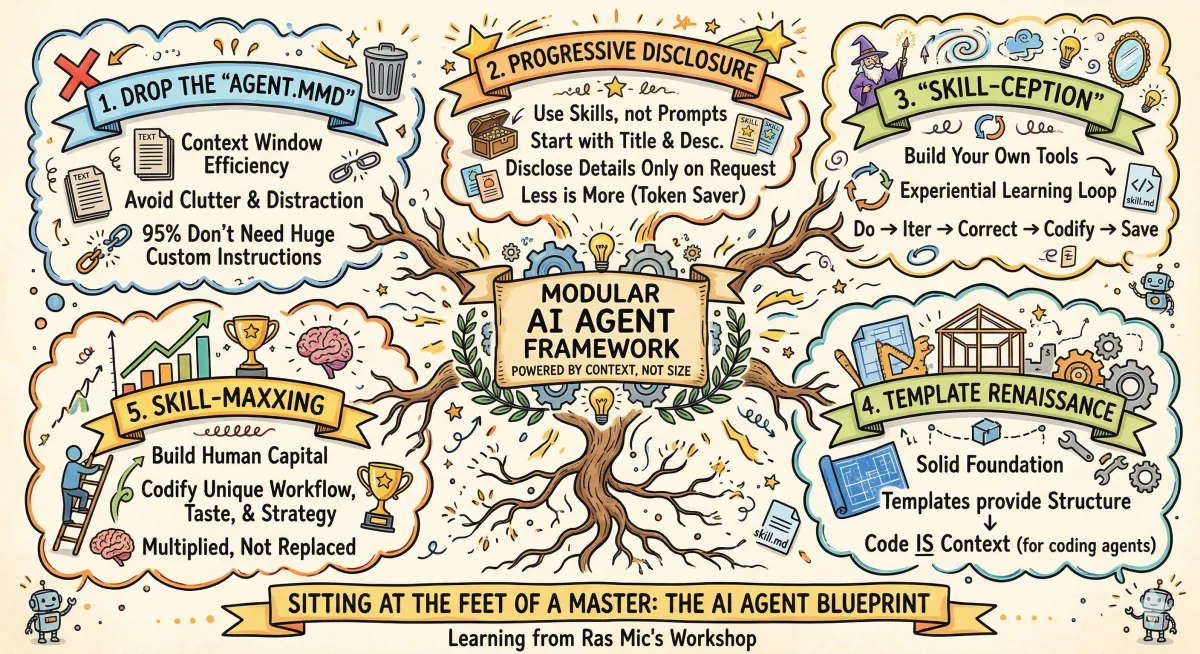
1. Stop Overloading the Brain (The Death of Agent.mmd)
We used to think we had to give an agent a massive "identity" file (like an agent.md) that it read every single time.
The Insight: Ras Mic points out that 95% of people don't need these files. They waste tokens and distract the model. Unless you have highly proprietary data or a very specific internal methodology, skip the "mega-prompt."
The Master’s Way: Instead of a heavy backpack of instructions, give your agent a tool belt of skills.
2. Progressive Disclosure: The "Skill" Secret
This was the "aha!" moment for me. Instead of giving the agent all the info at once, Ras uses Progressive Disclosure.
The Skill File: You create a
skill.mdfile.The Hook: Initially, the agent only sees the title and a short description of the skill (costing maybe 50 tokens).
The Execution: Only when the agent decides it needs that specific skill does the "harness" disclose the full, detailed instructions (which could be 1,000+ tokens).
This keeps the AI’s "working memory" (context window) lean, focused, and fast.
3. "Skill-Ception": How to Build Your Own Tools
Don't go to a marketplace to download random skills. Ras Mic is clear: Build your own. It’s like training a new employee. You wouldn't just give them a random manual from another company; you'd show them how you do it.
The Workflow:
Manual Run: Do the task yourself with the agent.
The Iteration Loop: When it fails (and it will), tell it exactly why. "You missed the TrustPilot check," or "The summary was too long."
Codify the Success: Once it nails it, have the AI look back at that successful conversation and say: "Write a skill file based on this successful run." This is "Skill-Ception"—using the AI to codify its own best behavior.
4. The Template Renaissance
When it comes to building code, Ras Mic argues that the code is the context. You don't need a text file explaining your tech stack.
What you need is a solid foundation template. If you give an agent a clean boilerplate for a web app, it can read the structure and immediately understand the "vibe." The template provides the guardrails so the agent can focus on building features rather than guessing the architecture.
5. Scaling via Sub-Agents
The master’s advice on scaling? Don't. At least, not at first.
Start with one agent and build its skills until they have a 100% hit rate. Only once that agent is "skill-maxxing" and getting overwhelmed should you introduce sub-agents. Think of it as a hierarchy: one manager agent overseeing specialized workers who each have their own specific skill sets and context.
The Takeaway: It’s All About Taste
At the end of the day, AI models are token predictors, not thinkers. What makes an agent truly "elite" is the human taste you bake into the skills. Your specific workflow, your standards for quality, and your strategic "edge" are what you are codifying.
As Ras Mic says, the "underclass" of the future won't be people replaced by AI—it will be people who didn't bother to learn how to build these skills.
Tinkering Tip: Try the "Manual-to-Skill" method today. Pick a repetitive task you do with AI. Force yourself to walk through it step-by-step, correcting the AI until it's perfect. Then, ask it: "Now, turn this entire process into a .md skill file titled [Task Name] Skill." You’ve just built your first piece of digital capital!
Special thanks to Ras Mic and The Startup Ideas Podcast for sharing this masterclass in agentic workflows.