What Michelangelo Can Teach You About AI Adoption
What Michelangelo Can Teach You About AI Adoption
By David Ortiz · March 3, 2026
Michelangelo didn't just paint. He sculpted, sketched, designed buildings, wrote poetry, and ran a workshop full of assistants and specialists. The Sistine Chapel didn't happen because he found one perfect brush.
And yet, when most professionals think about "getting into AI," they're essentially looking for one magic button.
I know. Comparing a CPA firm or a law practice to the Sistine Chapel sounds like something a motivational speaker says before charging you two grand for a weekend. Bear with me.
The Magic Button Problem
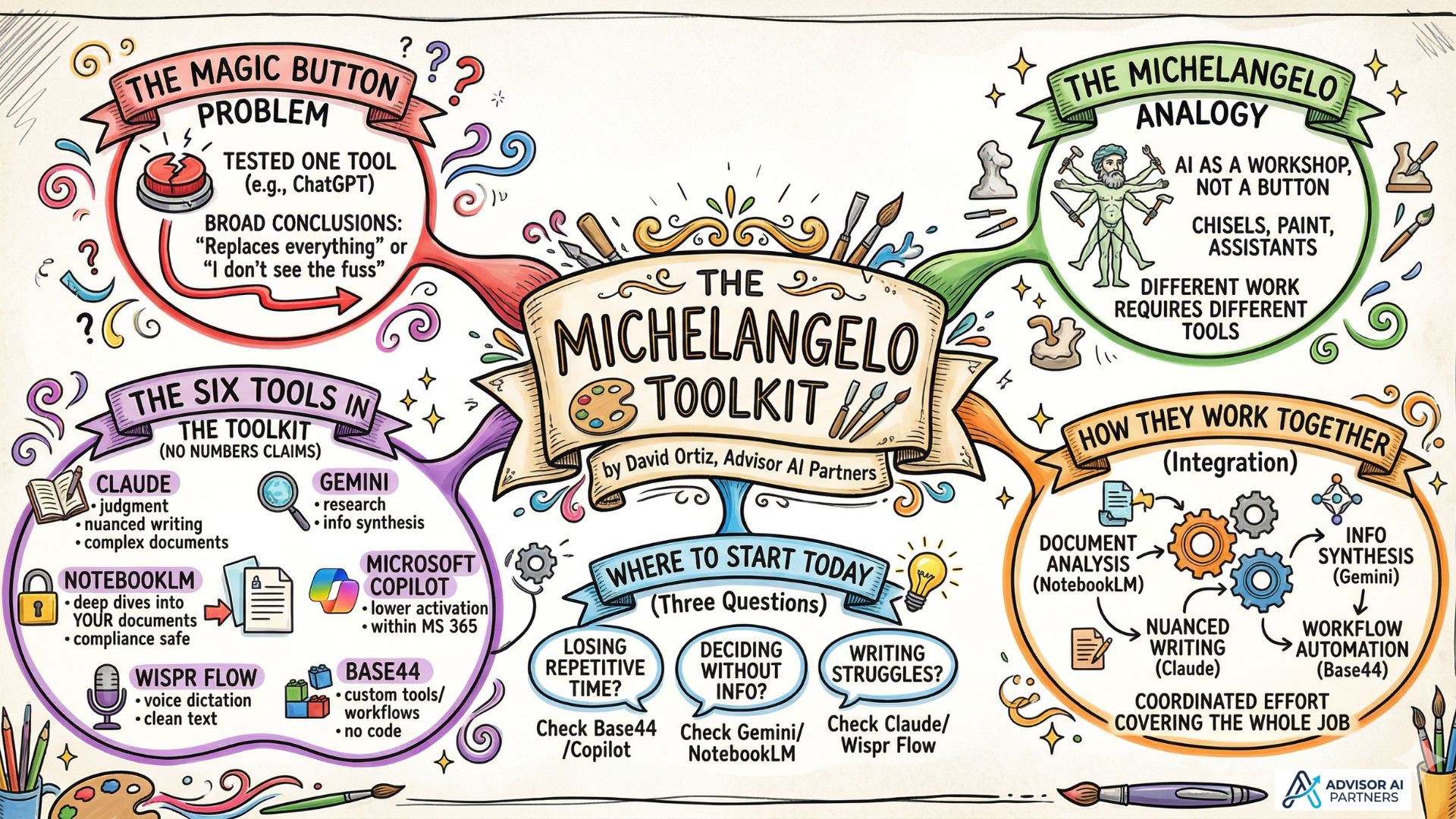
Here is how it usually goes. Someone hears about ChatGPT. They try it once to write a LinkedIn post or a recipe for chili. Maybe it's impressive, maybe it's not. Either way, they walk away with one of two conclusions: "This is going to replace everyone" or "I don't see what the fuss is about."
Both are wrong. They tested one tool for one thing and decided that was the whole picture.
AI isn't a button. It's a workshop.
Michelangelo understood something most people skip: different work requires different tools. He didn't use a marble chisel to apply fresco. He didn't paint with a sculpting pick. Each tool had a job. The art came from knowing which one to reach for at the right moment.
That is exactly how I think about AI in a professional services practice.
The Real-World Result
I recently worked with a CPA who was spending thirty hours a month manually reviewing compliance files. It wasn't that she was slow. It was that her process was built for a world where humans had to read every single line of fifty different documents just to find one inconsistency.
We didn't give her a "magic button." We gave her a workshop.
By the time we were done, those thirty hours were down to five. We didn't replace her judgment--we just removed the twenty-five hours of "hunting for things" that kept her from actually using it.
The Michelangelo Toolkit
Over the past few years, I've landed on several tools that cover the full range of what professionals actually need. Not a random list--six tools that each do something the others can't.
Claude is where I go when I need to think. It handles long, complex documents and nuanced writing better than anything else. If the work requires judgment--not just execution--Claude is the tool.
Gemini is my research engine. It handles the kind of broad information gathering that used to eat entire mornings. When I need to understand a new regulation or a market shift fast, Gemini is how I start.
NotebookLM is for going deep into your own data. You upload your firm's materials, your SOPs, or your client files. It doesn't guess based on the internet--it works from what you gave it. In a compliance-heavy practice, that distinction is everything.
Wispr Flow is how I get out of my own way. I think faster than I type. Most professionals do. Voice dictation that produces clean, usable text--not a transcription mess you have to spend an hour fixing--is the kind of small change that quietly returns hours to your week.
Base44 is where I build. No code. No developers. When I need a custom tool--like the CRM I built in a weekend--Base44 makes it real. This is the tool that turns "I wish we had a system for this" into an actual working platform.
How They Work Together
The mistake isn't using the wrong tool. The mistake is expecting one tool to do all six jobs.
The CPA I mentioned didn't just "use AI." She used NotebookLM for the deep document analysis. She used Claude to draft the client follow-ups. She used Base44 to automate the intake so her staff wasn't manually uploading files one by one.
No single tool does all of that. But together, they cover the whole job.
Three Questions to Start Today
You don't need all six tools on day one. You need one problem and the right tool for it.
Where am I losing the most time to something repetitive? That's your Base44 or Copilot problem.
Where am I making decisions with information I don't fully have yet? That's your Gemini or NotebookLM problem.
Where does the quality of my writing fall short of what I know? That's your Claude or Wispr Flow problem.
Pick one. Start there. The rest of the workshop gets built from that first answered question.
The Renaissance wasn't won by the most talented people in Florence. It was won by the ones who picked up the new tools first.
Your workshop is waiting.
Ready to Find Your First AI Win?
One process. One experiment. That's how every Renaissance starts. Let's map yours together.